Cryptolocker is the nastiest virus I’ve seen in my computer repair career. It ups the ransomware stakes by encrypting your files and holding them hostage until you pay the ‘ransom’. Understand that your files can be lost forever. The virus is most commonly spread through email attachments. Phishing attacks have also been used against companies.
You might be thinking that someone will certainly break the encryption and put an end to the problem. However, the encryption is an asymmetric RSA that requires both a public and a private key. The public key is used to encrypt the files and the private key is used to decrypt the files.
Keep in mind that this is the same type of encryption that the US government uses, and by most accounts, the NSA is unable to break this style and level of encryption! Without the private key, there is no way to unlock your files. The types of files that are encrypted vary with the particular variant of the virus. But the virus appears to target businesses, based on the targeted file types but also affects many non-business users as well.
The current cost to release your files is $300 but I’ve seen some variants of the virus seeking up to $500. Paying the ransom might or might not be successful in releasing your files. Many times it is NOT. I would not suggest paying the ransom. The success rate of recovering files this way is not high. The lesson here? Back up your files. Period. The virus infection, like other virus and malware infections can easily be removed by a qualified computer repair shop for around $125. The problem here is the encrypted data. If you data is backed up – although you’re not perfectly protected against the infection – you’re protected against data loss. See my blog for more articles on how to back up your data.
A new version of the virus, referred to as Cryptolocker 2.0 was recently discovered at the end of 2013, though the original version is still in full-force. Both versions asymmetrically encrypt files with particular file extensions and then request a ransom.
There are a few differences:
1. The earlier version uses RSA-2048, while 2.0 uses RSA-1024. However, the latter claims to use RSA-4096.
2. 2.0 only accepts Bitcoins for the ransom payment. The previous version accepts Ukash, MoneyPak, cashU vouchers, or BitCoin.
3. 2.0 was programmed in C#. The original Cryptolocker was programmed in Visual C++. This strongly suggests that the original programmers were not part of the new version.
4. Cryptolocker didn’t attack video and music files; the latter version does.
Experts are uncertain whether the same programmers created the 2.0 version or if it is merely a copycat. Though most believe it is was not created by the original programmers. There is one certainty; both can be detrimental to your files. Avoid opening email attachments unnecessarily, back up your files at regular intervals, learn good web-browsing habits — and run an effective and up to date anti-virus program.
[socialring]

Author Archives: Chris Calkins
5 Simple Data Backup Methods to Avoid a Data Loss Catastrophe
 Of all the important computer tasks that people regularly ignore, backing up their data and important files must be at the top of the list. At my computer repair shop in Louisville, KY at least once a week I deal with a customer in a panic because their computer or laptop won’t start and it is the only device that contains all their data. With computers, things can go very wrong, quickly. Hard drive failure is a very common occurrence and now there is computer virus going around that destroys data.
Backing up your computer and keeping your files safe should be a regular part of your computer maintenance routine. The frequency will depend on the importance of your files – the value you place on them. It’s advisable to backup immediately after uploading anything you consider important. A common sense test would be to ask yourself how you would feel and how would it affect you if the file was gone. For most users, once a week, bi monthly, monthly or even quarterly is a reasonable schedule. Again, depends on the value you place on the newly created files.
Perhaps, part of the problem lies with the fact that people aren’t sure how to start or what tools and software to use. If I have any advice along these lines it is one thing: keep it simple. I recommend keeping your data on two devices. Your machine and one other device. If it’s at your home or facility or at someone else’s (meaning the cloud – which simply means your data is transferred to someone else’s facility via the internet not into outer space) makes little difference really unless you’re concerned against protecting against a flood or fire. In which case you do need a copy at another facility – but you still don’t have to use the cloud. You can give a copy to friend, or put a copy in your bank box for example. No need to send it via the cloud to someone stranger’s facility.
I do not use a cloud back-up. The only solid, logical reason to do a cloud back up that I can think of is to protect against fire. Rather than losing control of my data and sending it to ”who knows where” I simply have a third copy of my data on a flash drive in the bank box. This is simple and logical to me and makes me feel happy.
I also keep the backup itself simple and logical (by my way of thinking, anyway). I transfer (copy and paste) five folders and my accounting file to an external hard drive about once a month. That’s it! The folders are: My Documents, Business Documents, My Pictures, My Videos, and Favorites. I use QuickBooks accounting software for my businesses and each business has one file that I save to the external.
My backup method is very simple as I think it should be. I am in control of my data and my back-up and quite frankly I don’t think this needs to be automated process. Automated back-ups can fail and drain system resources I’d rather use for actual creation and production. But as my grandmother, who lived to be 100 always said “to each their own.” Here are some more back-up options for you to consider.
1. External Hard Drive: The most common method for backing up computers at home is the use of an external hard drive. These devices come with software to make backups automated but you don’t have to use it. You do have to option of using the backup software, or just dragging and dropping your data or if you prefer – cut and paste. This is a very inexpensive option a 500GB external Hard Drive is about $59 bucks now.
2. USB Flash Drive: You’re not likely to be able to fit all the contents of your hard drive on a flash drive but this isn’t the way you should be doing a back-up anyway, in my option. The capacity of these little drives is impressive. You can get a 64 GB or 128 GB flash drive which is enough to back up all of my important, irreplaceable data. It’s a great way to go, frankly.
3. Online Storage: Dropbox is one such option. This software also allows file sharing with other people. The first 2 GB of space is free. There are other comparable solutions — Cabronite and others. I don’t use cloud back-up so I can’t give you many options here but Google it and I’m sure you’ll get a Google-zillion results. Search criteria: “best online back-up” –read some third party reviews and articles about your options.
4. Windows Backup and Restore: While previous versions of Windows had backup utilities that left a lot to be desired, the back and restore utilities in Windows 7 and 8 are actually OK but this my least favorite way to back up data. I would pass on it.
5. NAS – Network Attached Storage: NAS is a good option sometimes for business users and it wouldn’t be entirely incorrect to think of this as an external hard drive for a network of computers. Unless you enjoy complicating your life more than it already is I would stay away from this for home use.
If you need help with computer data backups in Louisville, KY call On-Site Louisville Computer Repair Co. today.
[socialring]
What Does The “Blue Screen of Death” Actually Mean? (Updated 2026)
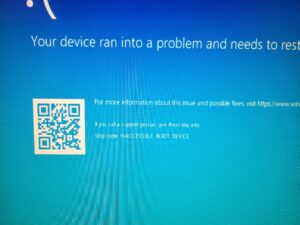 If you’ve ever booted up your computer and faced a blue screen, you know the feeling that results. Sometimes this is called the Blue Screen of Death (BSOD). Many computer users at some point have experienced it. Will your computer ever boot up properly again? These panicked thoughts are all too common. In fact, not too long ago MY computer blue-screened.
The BSOD has been a feature of all Windows-based operating systems since Windows 3.1. Software developers invented the term ‘blue screen of death’ to accommodate the color of the screen and the finality of the situation . . . but only the situation, not the computer. It refers to the “death of your computer processes” not the “death of your computer.” And, this is almost always the case. Your computer is still alive. A process is dead which can be caused by either hardware or software.
The Blue Screen of Death is more formally and accurately referred to as a STOP error. It’s an error serious enough to ‘stop’ the computer’s processes. Troubleshooting is challenging, since a STOP error requires a restart. It is often necessary to seek out the help of a qualified computer repair shop to assist you in troubleshooting the error. File issues can cause these errors, but hardware problems are also common. These can include a faulty power supply, physical memory issues, and overheating. The causes can be wide-ranging. This is part of the challenge to finding a solution.
In most cases, a STOP error provides an error code. This is the key to rectifying the issue. Unfortunately, some error codes are more difficult to manage than others.
Three of the most common blue screen error codes:
-
- UNMOUNTABLE_BOOT_DEVICE: A corrupt of missing low-level system file is the most common cause for this error message. The issue can be related to a physical failure in the drive, though the problem is most commonly associated with file corruption.
- UNMOUNTABLE_BOOT_DEVICE: A corrupt of missing low-level system file is the most common cause for this error message. The issue can be related to a physical failure in the drive, though the problem is most commonly associated with file corruption.
-
- PAGE_FAULT_IN_NON_PAGE_AREA: This is one of the less descript error messages. This category of error is very general and can be related to numerous types of errors. The full error code can be useful to narrowing down the problem. Troubleshooting this type error can be especially challenging. Chasing down these error codes can be analogous to going down a rabbit hole. Although often the problem can be RAM memory (short term memory). You can check this by removing one RAM memory stick at a time and seeing if this solves the problem. Just make sure your machine is off and unplugged when you remove or install RAM.
- PAGE_FAULT_IN_NON_PAGE_AREA: This is one of the less descript error messages. This category of error is very general and can be related to numerous types of errors. The full error code can be useful to narrowing down the problem. Troubleshooting this type error can be especially challenging. Chasing down these error codes can be analogous to going down a rabbit hole. Although often the problem can be RAM memory (short term memory). You can check this by removing one RAM memory stick at a time and seeing if this solves the problem. Just make sure your machine is off and unplugged when you remove or install RAM.
-
- DRIVER_IRQ_NOT_LESS_THAN_OR_EQUAL_TO: A device driver can be the cause. Usually a forced Windows update can fix driver problems somewhat naturally. This can also be a ram or drive failure.
- DRIVER_IRQ_NOT_LESS_THAN_OR_EQUAL_TO: A device driver can be the cause. Usually a forced Windows update can fix driver problems somewhat naturally. This can also be a ram or drive failure.
-
- CRITICAL_PROCESS_DIED: This error has become increasingly common in modern systems, especially with Windows 10 and Windows 11. It indicates that a critical system process has unexpectedly stopped. This is often caused by corrupted system files, failed updates, or conflicts with antivirus or security software. In many cases, running system file checks or performing a startup repair or a clean OS install can solve the problem. If after a clean OS install you still have the message — it’s hardware.
- CRITICAL_PROCESS_DIED: This error has become increasingly common in modern systems, especially with Windows 10 and Windows 11. It indicates that a critical system process has unexpectedly stopped. This is often caused by corrupted system files, failed updates, or conflicts with antivirus or security software. In many cases, running system file checks or performing a startup repair or a clean OS install can solve the problem. If after a clean OS install you still have the message — it’s hardware.
- DPC_WATCHDOG_VIOLATION: Frequently seen on newer machines using SSDs, this error typically points to driver or firmware issues—especially with storage controllers or outdated drivers. It can also occur after major Windows updates. Updating drivers, SSD firmware, or BIOS/UEFI settings is often required to fix the problem.
Depending on the operating system, a blue screen error consists of a hexadecimal error number, the name of the error in CAPS, and four parameters that can assist the computer technician in identifying and fixing the error. It might also include the address where the error occurred. Be sure to record the error messages; they can be instrumental in finding the right solution.
In most cases, a blue screen error code is not the end of your computer or your data. An experienced error code troubleshooter can, in most cases, solve the problem without a loss of data or computer functionality.
If you find yourself faced with a blue screen, there’s probably no reason to panic. Your local computer expert can probably find the solution quickly and effectively.
In 2026, blue screen errors still occur, but they’ve evolved. Modern systems like Windows 10 and Windows 11 now display more user-friendly crash screens, often including a QR code and clearer messaging. These improvements can help users quickly look up solutions or provide better information to a technician. Additionally, with the rise of SSDs and improved system protections, many crashes today are more commonly linked to driver conflicts, failed updates, or security software issues rather than traditional hard drive failures.
Another important 2026 trend is the increase in blue screens caused by updates and firmware-level issues, especially with newer hardware and BIOS/UEFI changes. We are also seeing more cases tied to corrupted updates, GPU driver instability, and even third-party security tools conflicting with system processes. The good news is that recovery tools have improved significantly—features like automatic repair, system restore, and cloud-based reinstall options make it easier than ever to recover a system without losing data.
For more information on computer repair related topics or information on computer repair in Louisville, Kentucky visit the company website here.
[socialring]
9 Creative Ideas For Your Old Computers and Printers
 At some point, all computers become obsolete. The situation with printers isn’t much different. Printers have a finite life and aren’t supported indefinitely. What can be done with old printers and computers? There must be something better than throwing them in the trash. Here are a few ideas to consider.
1. Donate it: Many local schools, daycares, charities, and churches would like to have your old computer or printer. The local school computer lab might like to have it for parts. It’s possible to get a tax write-off, too. Perhaps a friend would like it. There are also international organizations that take donations of computers and some even attempt to rebuild them for underprivileged children. See PC United and Computers for a Cause to read about two of these organizations.
2. Experiment with it. If you’ve ever been interested in an alternative operating system, like Linux, your old computer might be the perfect testing ground. You might want to take your old computer apart and learn about how it works. There might be something interesting inside of that old printer, too. If you’re interested in computer electronics this is a good opportunity to study them a bit. What do you have to lose?
3. Sell them. They might only be worth a few dollars, but something is better than nothing. Try ebay or craigslist. Someone is likely to want your old stuff, for the right price.
4. There are buy-back programs for printers. Hewlett-Packard will buy back printers from any manufacturer. Staples will recycle Dell printers for free and others for a small fee. From time to time, they offer rebate incentives toward a new printer purchase.
5. Dedicate it to a single task. You might want to use that computer only for word processing, or multiplayer gaming, or as a multi-media station. You might want to use it to play older games that only run on DOS on Windows 98. Maybe you do graphics work part-time. It can be handy to have a dedicated computer.
6. Create a home network. An old computer isn’t the best server, but for a small home network, it can be entirely usable. It’s good experience, and the whole family can benefit.
7. Use it as the ‘family’ computer or printer. It can be nice to have a light-duty computer that’s used in front of the TV for simple gaming or Internet surfing. You probably don’t want your 5-year old on your brand new laptop anyway.
8. Use it for parts. If you like to build computers, the old computer can be used for parts. Maybe you only want the case and power supply. Or perhaps the hard drive is relatively new, and you’d like to salvage it. Printer parts are bit more challenging to salvage, but it can be done.
9. Recycle it. Almost every community has a recycling center that takes computers. You can do a Google Search for “computer recycling” and probably get some good results. These organizations will make sure nothing is wasted on the computer or laptop. This might be the best option for the environment.
If another person/organization will be getting your computer, be sure to remove all traces of personal programs/data before it leaves your possession. There is feature in Windows 8 called ‘Remove Everything’ and will remove everything from the hard drive and install a fresh copy of Windows. Other versions of Windows will require other means. If you are not very computer saavy you might need to contact your local computer repair shop and ask if they do secure data destruction before you release your old machine to another person or organization. You don’t want your personal data in the wrong hands. For more information on computer repair in Louisville, KY or related articles you can visit our blog called PC News.
[socialring]
7 Do-It-Yourself Computer Service Tips

Just like your automobile, your PC requires regular service as well – for both software and hardware components. Computers are surprisingly durable, considering the amount of abuse they seem to take. But they don’t operate at optimal efficiency without a little work. Note: none of these tips is a replacement for an annual virus check and tune-up from your local computer repair shop or computer repair professional.
Here are several items that can be done to keep your computer in good working order:
1. Blow out the cooling fan(s). Have you ever noticed a room fan tends to accumulate dust? Your computer fan is no different. There’s a static charge on all fan blades that attracts dust, which is also charged. This dust can easily be removed with a can of compressed air. For a laptop make sure an angle the spray so that dust is not blown back into the computer. For a desktop computer you have to remove the side of the case.
2. Clean the screen. Over time, the grime that accumulates on the screen can scratch the surface. Remember that LCD screens are not made of glass; the exposed surface is actually plastic. The first step is to turn off the laptop or monitor. Then, lightly remove the dust with a microfiber cloth. There are LCD screen cleaning kits available that include cleaning solutions. You can make your own by mixing water and isopropyl alcohol in a 1:1 ratio. Be sure to use a cloth that won’t scratch your screen. Make sure the screen is dry before turning the power back on. If you use a cleaning solution from the store make sure it is mild and do not spray directory on the screen or monitor.
3. Clean your keyboard. All kinds of particulates and dust eventually find its way into your keyboard. You can clean this following the steps below:
• Spray surface dust off with compressed air.
• For a Laptop turn off the computer and clean the key surfaces with a damp cloth. Be wary of harsh cleaners. Some will dissolve plastic.
• Some laptop keyboards have removable keys so be careful not to pop them off. Clean around the keys with an alcohol soaked q-tip swab.
4. Keep your computer cool. Avoid using your laptop or computer in extremely hot conditions. Computers generate a lot of heat themselves so keep them away from the central heat fan exhaust vents or out of rooms that are very hot for some reason.
5. Avoid installing unnecessary software. Try hitting ctrl-alt-del and look at your task manager sometime. It’s amazing how many programs are running in the background and using important system resources. Don’t add to the mess unnecessarily. If you have programs you’re not using, ditch them. Uninstall them from the control panel. If they won’t uninstall and you suspect they are causing dysfunction on your computer see step 7 below.
6. Run system utility programs on a regular basis. Windows has built in utilities to help you keep your computer in tune. You can use the windows defragmentation tool or the disk clean-up utitlity to clean up your computer. And there are programs such as CCleaner from Piriform available that will remove junk files and help you do your own mini computer tune-up. You can download it here.
7. Run a malware program on a regular basis. Viruses, worms, Trojan horses, and so on can wreak havoc on a computer system. Use an anti-malware program on a regular basis. You can download a free one called Malwarebytes here. Note: If your computer is running very slowly you might have a serious virus infection and should seek the assistance of a qualified computer repair shop or computer repair professional for assistance. You can find more informative articles on basic computer service at my blog entitled PC News or on my website.
[socialring]
Laptop Repair – Should I Fix It or Just Replace?
 Laptop repair is frequently a better option than replacement. And if you find the right computer repair shop, there’s a good chance your laptop can be saved for a modest cost. But it’s not always easy to determine the best solution. Some repairs are almost too expensive to justify. And some laptops are simply at the end of their lifespan. Below are some tips.
Consider the following when deciding to repair or replace your laptop:
1.Determine the source of the problem.
Some laptop issues are an easy fix – some aren’t. The first step is to research computer repair shops online and find one with a good reputation. When you drop off your laptop ask the laptop repair technician to call you with an estimate BEFORE the repair is started. A qualified and competent computer repair technician should be willing and able — after accessing your laptop issue — to help you decide if it is worth fixing or if it’s time to replace.
2.Consider your options. With good information, the available options can be considered.
How serious is the problem? Some problems are a huge hassle and hardly worth the money. Failed components, a hard drive for example, are an easy and relatively inexpensive fix. Laptop screen repair is a fairly inexpensive fix. Conversely, a failed motherboard is quite expensive to replace and can take several weeks.
Is your laptop older than 5 years? Most experts feel that a computer older than five years is nearing the end of life expectancy, and anything less than 3 years should be repaired. But this is only a generalization and there are many other factors to consider.
What is the cost of a new laptop? What would you gain with a new laptop? Do the newer models have features that are important to you? Consumer Reports states that a computer should be repaired if the cost is less than half the cost of a similar, new model. Higher quality and more expensive laptops are generally more worthy of repair.
3. Do Your Homework
Does the repair company have a good reputation? There’s nowhere to hide online. A laptop repair company’s reputation is easy to find with a little digging. A good reputation can be worth more than a good price.
Will they be using new parts or refurbished? Both can be acceptable, just be sure you know what you’re getting and the price is appropriate.
How long will it take? Can you live without your laptop during that time?
Is there a warranty? How long does it last? What does it cover?
Before getting rid of your broken laptop, consider the possibility of repair. It’s possible that your laptop needs a minimal amount of repair or maintenance to get it back in working order. The cost savings can be put to better use. For more information on Laptop Repair in Louisville, KY or for more blog articles like this visit our website. And if you’re uncomfortable with the process feel free to call us for advice before you make a decision. We will be glad to help. For more information on computer repair topics visit our website for all the latest laptop and computer repair news.
[socialring]
Famous Computer Viruses
Melissa
Named after a stripper from Miami, this computer virus was created by David L. Smith from New Jersey. It was first reported on March 26th 1999. The virus was not originally created to cause loss or damage but it did run havoc in the computer world. Regarded to be the fastest spreading virus ever, it was initially sent through e-mail. The email consisted of an attachment called “List.DOC” with a subject line “Important Message From {the senders name}” with a small message which read “Here is the document you asked for… don’t show anyone else.” Once the attachment was opened, the virus would infect the computer and would then access the Outlook address book and send the same message to the first 50 names in the address book. Though the virus does not destroy file or steal data, the ripple of emails forced companies to shut down their email server. Companies like Microsoft and Intel were also affected.
MyDoom
MyDoom is known to be one of the most destructive computer viruses ever and also holds the record of the most rapidly spread virus. This virus would attack the operating system of the computer and then would replicate itself and send itself to different users from the email address book. Its spread through email was successful because it appeared as an email delivery failure report, which when opened and investigated by the user would infect his computer. MyDoom would also send requests to search engines and send emails to the addresses found in the search result. This resulted in crazy traffic on search engine sites like Google and Yahoo. The search engine servers were slowed and had to be shut down, temporarily.
Storm Worm
It is a younger virus when compared to the above two. Found out in late 2006 or early 2007, the Storm Worm virus has around ten million computers on its victims list. A “Trojan Horse” program converts the affected computer into a puppet (a computer that can be controlled remotely). It was originally distributed through email with a subject line of “230 dead as storm batters Europe.” Once the computer was infected by the virus, the computer got attached to a botnet from where it could be controlled by the attacker. These computers were then used to send several spam mails across networks. Though it is very easy to detect this virus and remove it from your computer, often a computer has to be taken to a qualified computer repair professional to have it removed completely.
The FBI Moneypak Virus
The FBI Moneypak virus, also known as the FBI Virus, is one of the latest viruses in the “ransomware” category. It was invented and is kept going by a Russian Gang many of whom have been arrested but the virus keeps popping up anyway, despite arrests. At my computer repair shop in Louisville, KY I have done virus removal for this virus a hundred times in past few years. It is common enough, I going to classify it as famous, or infamous, at this point. The virus, when it enters a computer system — locks it down. The user can see a screen, with the FBI logo on it. The text on the screen states that the computer has been locked down for a supposed criminal code violation. Illegal activities like downloading and distributing copyrighted material is one of the major reasons displayed. Then it asks the user to pay a fine through Moneypak to avoid criminal charges against them. Many users are so scared, apparently, they retrieve a MonkeyPak Card, usually from Wal-Mart and pay the fee. However, the computer does not get unlocked once the money is paid. You need to remove the virus to regain control of your computer. You will find a lot of people offering suggestions on how to remove this virus; however, for complete removal it’s best to take your computer to a local computer repair shop or have a computer repair professional come to your location for removal.
Internet Security Virus 2013
The last on our short list here is a very legitimate looking “fake antivirus” software that may not harm your files but is dangerous nonetheless. It mimics very precisely the exact software that is supposed to be protecting you from it –your antivirus software suite. It disables important functions on your computer that are important in detecting a malware intrusion –than takes over your PC. It normally appears as a pop-up when you are browsing the net; it warns against your computer being infected and asks you to click a link to clean it. Thinking it is your honest antivirus software you click “remove viruses.” When you try to remove these infections you are asked to buy the full version to remove the infections. Very tricky. I’ve seen countless people fall for this and pay the fee only to discover that their money is gone and they still have the virus. To fight removal the virus disables Windows Restore, Windows Task Manager and Registry Editor and sometimes even your internet connection. This virus is almost impossible for even the most advanced computer user to remove and almost always requires professional removal.
For more articles on computer viruses and computer virus removal visit my website or my blog at PC News
[socialring]
Holiday Shopping Online This Year? Stay Safe With These 5 Tips
This holiday season is the first year that more people are expected to shop more online than in actual brick-and-mortar stores. It’s expected that over $63 billion dollars will be spent on holiday shopping in the United States. That’s an increase of over 16% from last year. With so much money being spent online, it begs the question, “How can you protect yourself from identity theft and other cybercrimes?”
1. Use a credit card instead of a debit card. While both offer the same amount of liability protection, you have much longer with a credit card to realize that you have an issue. Both types of cards limit your liability to $50. This is the law. However, you have 60 days to notify your credit card company that something is wrong. Debit card companies limit you to 2 days.
• If you’re a victim of credit card fraud, you’re not out any money. But if someone uses your debit card without your knowledge, your entire bank account could be cleaned out before you know it. It can take weeks to get your money back. What would you do in the mean time?
2. Consider not shopping online in public places. It’s possible for hackers to access your computer if you’re utilizing wireless Internet in public places. Feel free to do your browsing in public places, but save your shopping for a network that requires a password. It’s also important to prevent your wireless devices from automatically connecting to any Wi-Fi signal you happen to stumble upon.
3. Stick to stores you know. If you’ve used an online store successfully in the past, it’s reasonable to assume that you’ll be safe in the future. If you’re unsure about a new store, do an online search. It’s difficult to hide bad news today. The word spreads quickly. If you’re feeling uncomfortable, trust your gut.
4. Look for the symbols of security. A web address that starts with ‘https’ includes an encrypted protocol. You’re probably also familiar with the little padlock that shows up in the address bar, immediately before the ‘https’. This is also a sign that the website has some degree of security and encryption. Depending on the browser, the color of the padlock can mean different things. A green padlock typically means that the web address has been verified using a security certificate. A gray padlock can mean that you’re on the right site (it’s not being spoofed); however, the owner of the website hasn’t been verified. Avoid purchasing on sites that don’t have some sign of security.
5. Leave the pop-ups alone. Control+F4 or ALT F4 will eliminate most pop-ups without having to click on them. Control+W works for Macs. You are NOT going to get a free iPad or $500 gift card. Pop-ups are a common source of computer malware and computer viruses (read more about how to prevent computer viruses here.)
Shopping safely online should be on everyone’s mind. Take care of yourself and your finances by taking the necessary precautions. Few things can spoil the holidays quicker than realizing that someone has used your identity to purchase expensive items. Save yourself the grief and shop intelligently this holiday season.
[socialring]
Mastering the Art of Online Searching: Tips to Find Exactly What You Need
 The internet is a vast and powerful tool, allowing you to find anything from the best chocolate chip cookie recipe to strategies for building wealth. While search engines have become smarter and more intuitive, finding the exact information you need can still be a challenge. If you’ve ever struggled to track down the right answer, you’re not alone. Fortunately, with a few simple search techniques, you can refine your results and get straight to the good stuff.
1. Be Specific with Your Keywords
Vague searches often lead to broad or unrelated results. Instead of searching “history of American cars,” try “Henry Ford impact on American automobiles.” The more precise your keywords, the better your search results will be. Every industry or subject has its own terminology—learning and using it can drastically improve your success.
2. Choose the Right Search Engine
Google may be the go-to for most people, but it’s not always the best option. Different search engines specialize in different types of content. For example:
- Google Scholar (scholar.google.com): Ideal for academic research.
- DuckDuckGo (duckduckgo.com): Focuses on privacy and unbiased search results.
- Wolfram Alpha (wolframalpha.com): Great for solving math problems and answering factual queries.
- Picsearch (picsearch.com): Perfect for finding images with a massive indexed library.
Taking the time to explore alternatives can help you uncover more relevant results.
3. Use Advanced Search Features
Most search engines offer advanced search options that help refine your results. For example, Google allows you to:
- Exclude words by using a minus sign (e.g., “jaguar -car” if you’re looking for the animal and not the car brand).
- Search within a specific site using “site:” (e.g., “Windows 11 tips site:microsoft.com”).
- Find specific file types with “filetype:” (e.g., “marketing strategies filetype:pdf”).
Exploring these features can dramatically improve the accuracy of your searches.
4. Use Quotation Marks for Exact Matches
If you’re searching for a specific phrase, enclose it in quotation marks (e.g., “best ways to improve memory”). This tells the search engine to look for that exact phrase instead of individual words scattered across different pages.
5. Utilize Search Operators
Google offers a variety of search operators to refine results. A few useful ones include:
- Price range: Searching “laptop $600…$1200” will display laptops within that price range.
- Define words: Typing “define:cryptocurrency” will give you an instant definition.
- Related sites: If you like one website and want similar options, use “related:” (e.g., “related:nytimes.com”).
6. Take Advantage of Free Search Courses
Google offers free online courses to improve your search skills. Their “Power Searching with Google” class is a fantastic resource for learning advanced techniques. Simply searching “Google search course” will lead you to their latest offerings.
7. Optimize the Length of Your Search Queries
Search terms should be detailed but not overwhelming. Start with a simple query and refine it if needed. For example, if “best smartphones” brings up too many results, narrow it down by adding specifics like “best smartphones for photography 2024.”
8. Stay Curious and Keep Experimenting
Becoming an efficient online searcher takes practice. The more you experiment with different strategies, the faster and more accurately you’ll find the information you need.
By applying these tips, you can cut through the clutter and get to the right answers quickly. Try them out today and watch your search skills—and your ability to find information—reach new heights!
[socialring]
Top Reasons Motherboards Fail
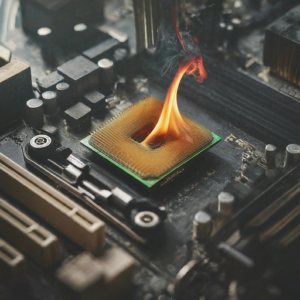 The motherboard is the heart of a computer. As long as your computer’s motherboard is intact – when things go wrong – your computer is often repairable at a reasonable cost. Motherboard repair or replacement, on the other hand, is usually very expensive. That said, there are several things to think about regarding prolonging the life of your motherboard. Here is a list of different reasons your computer’s motherboard might fail — along with suggestions on failure prevention.
PC Builder Damage
At least once a month I get a call from a PC Builder saying he or she just build a computer and it won’t come on. A nontrivial amount of the time the motherboard or CPU has bent pins or other damage such as: scratching or cracking the PCB, bent PCIe lanes, bent over capacitors etc. This could often be mitigated by the building watching Youtube videos about the build rather than forcing it.
Electrical Spikes and Surges
An electrical spike or surge is a short-lived burst of energy in an electric circuit. This can be the result of power hungry appliances, problems with wiring, problems with the power service outside the house, or the result of a lightning strike. Lightning is the #1 culprit of spike/surge motherboard failure I see — and it will often go in through the Ethernet port and bypass a surge protector! This sudden change of voltage can cause damage to the delicate circuits in a motherboard. Connecting your computer to a power outlet that has frequent fluctuations in electrical output may also cause damage to your motherboard. Though at times immediate damage may not be visible, it may harm the motherboard over time. To protect your motherboard from electrical spikes, use a high quality surge protector that can neutralize the effects. Unfortunately, it’s difficult to protect from lightning strikes.
Dust, Pet Hair and Debris
Dust pet hair and debris can be a sure motherboard killer. At my shop in Louisville, KY I can’t tell you how many times I see fans and fan basins clogged with dirt, dust, and debris. When these things collect in your machine, they start blocking the air circulation that keeps the machine cool. It is like harmful fat that blocks your arteries that cause a heart attack. A computer intake pulls all these things in when the fans rotate. This leads to blocking the airflow, which causes overheating.
Cigarette smoke
Tar from cigarette smoke (it’s not the nicotine, by the way) is not good for your health and also for the health of your computer. Cigarette smoke, when combined with dust produces a sticky gooey substance inside a computer. It smells bad and is also very difficult to remove. This tar can cause overheating — which may damage the motherboard. It is recommended that you have a periodic schedule of cleaning the interior of your computer (at a qualified shop) and try and keep it away from cigarette smoke.
Heating Issues
Overheating of the motherboard can occur if multiple operations are performed simultaneously and power supply is continuous (give your computer a periodic rest if gaming, watching videos, etc). Also, clogging of fans can cause a motherboard to overheat. In some cases, overheating may also occur due to fluctuations in power supply or in one of the parts of the motherboard circuit. Finally, using a laptop in your lap or on another soft surface can cover up intakes and exhaust fans causing your machine to heat up. Overheating can be prevented by keeping the fan basins clear, giving your computer a rest after heavy use, using your laptop in the cooler rooms in the house, and using it on a cold hard surface. Temperature monitoring software can be installed to monitor the temperature of your computer internally (Core Temp, Real Temp, SpeedFan).
Impact or Spill
An accidental impact to your motherboard can cause severe damage to the circuits which may cause motherboard failure. I have seen motherboards fail immediately due to impact from drops. Spill damage is also quite common. I have seen every type of liquid kill a motherboard instantly but thicker liquids (e.g., milk) seems to be the worst. Spills can cause your motherboard to short out instantly. Water can also cause damage to the different chips on your motherboard causing your motherboard to fail. If you do spill something into your laptop do NOT turn it on again and take it to a qualified computer repair shop, immediately.
Manufacturer Design Defects
Motherboards are mass produced and there are chances that manufacturing defects occur. Cheap motherboards also tend to fail more quickly. The capacitors installed may be faulty and may cause problems. The bus architecture of the board may have been engineered incorrectly and there might be cooling issues. Most motherboards come with a warranty so it should take care of expenses if problems arise during the warranty period, but that is often only a year and doesn’t cover user generated problems, of course. Sometimes the manufacturers admit to the faulty designs but usually not. Usually computer repair shops can tell if there is a “known issue” because we see the same problems occurring over and over with the same make and model of computer. I can see some trends related to certain generations of computers and it’s not with only one manufacturer. Sometimes these manufacturer defeats aren’t “known” for years (after enough of a make and model show up at the shops and enough complaints are filed that it becomes obvious there is a known issue with a particular make and model) and then it becomes more obvious based on discussions on the internet.
Normal Aging and Wear
Your motherboard will eventually fail (if something else doesn’t fail first.) This is a fact. It is an electric circuit board and has a finite life span. Some good motherboards will give you around fifty thousand hours of work time or even more if taken care of properly. Once they have reached their useful life span, they do fail and you may have to replace it or replace your computer. The good news is when you are aware of the reasons motherboards fail preventative and preparatory actions (see my article on backing up important files) can be taken to minimize the negative impact.
Please visit our website for more useful computer repair and topics.
[socialring]

RSS Feed
